Emergency Tree Removal and Storm Damage Cleanup in Danville, VA
When a tree comes down on a house, a car, or a driveway, Danville Tree Care & Removal responds across Danville and Pittsylvania County — and provides the photos and written documentation your insurance adjuster will ask for. Call (434) 216-5589.
What to do in the first ten minutes
If any part of the tree is touching a power line, stop and call the utility. Not us. A downed line can energize a tree, a fence, and wet ground around it. Danville Utilities inside the city, or Dominion, Appalachian Power, Mecklenburg Electric, or Southside Electric depending on where you are in the county.
Get everyone out from under it. A tree resting on a roof is holding load in ways nobody can see from the ground. Second floors and attic spaces under the strike are the wrong place to be.
Photograph everything before anything moves. Wide shots, close shots, the tree, the damage, the debris. Insurance claims turn on this and it takes two minutes.
Then call us. Tell us whether it’s on a structure, whether anyone is displaced, and whether the driveway is blocked. That’s what sets the priority.
This is not a rare event here
Danville sits about 200 miles from the Atlantic with almost no terrain in between to break down a tropical system, and a low-pressure lee trough tends to set up along the U.S. 29 corridor and fire off severe thunderstorms.
The record backs it up:
- 2018 — an EF-1 tornado on April 15; Tropical Storm Michael on October 10 with six inches of rain, more than $5 million in damage and two deaths; 15.2 inches of snow December 9–10. The year finished at 67.61 inches of rain, the wettest on record.
- September 27, 2024 — the remnants of Hurricane Helene produced an EF-2 tornado in Pittsylvania County, 118 mph peak winds along a 6.85-mile path ending about six miles west of Chatham. The National Weather Service survey recorded “numerous hardwood and softwood trees snapped and uprooted.” A second EF-1 touched down near Keeling the same afternoon.
- February 2021 — an ice storm left thousands without power across Halifax and Pittsylvania counties, with Danville Utilities crews working 16-hour shifts.
Ice is the underrated one. A quarter inch of radial ice adds hundreds of pounds to a single limb, and it loads pines and Bradford pears past failure faster than wind does.
What we handle on an emergency call
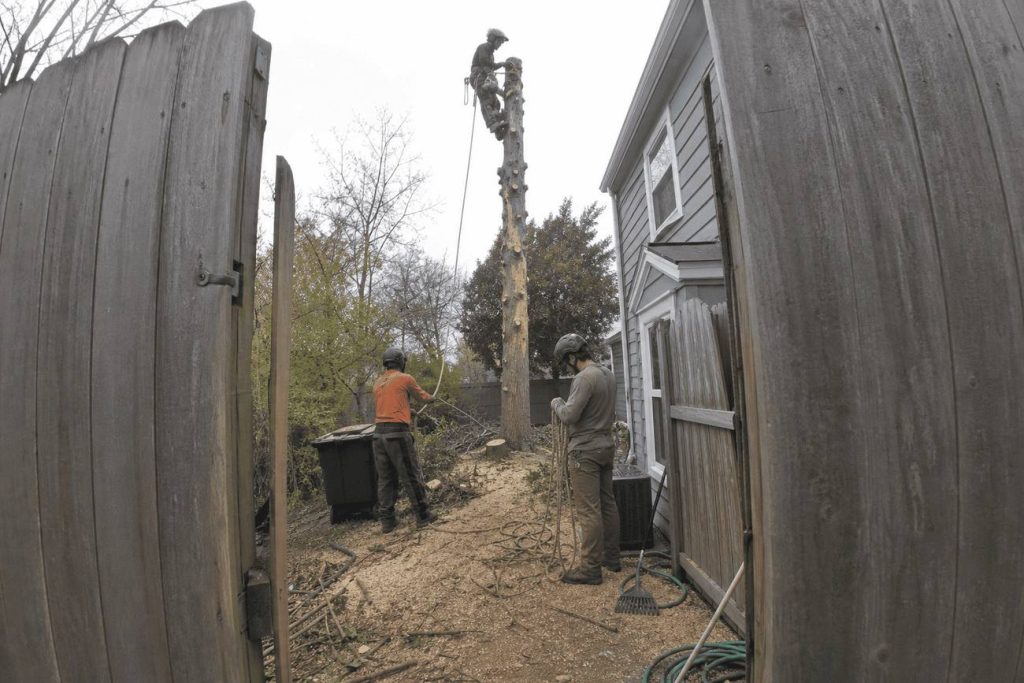
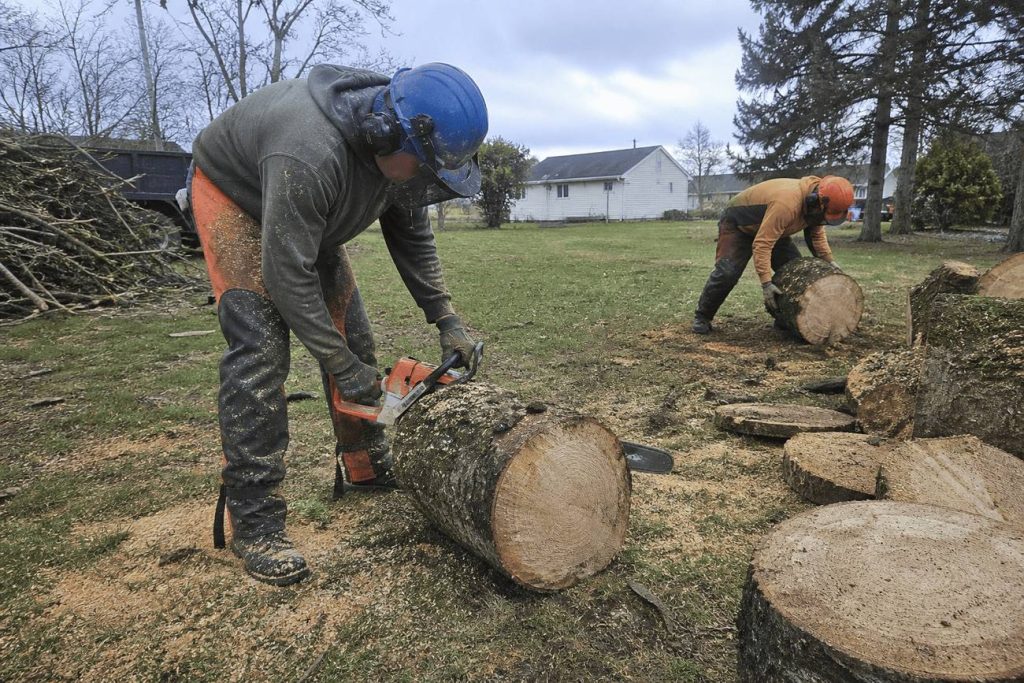
Trees on houses, garages, and outbuildings. Trees on vehicles. Trees blocking driveways and private roads. Hangers — broken limbs lodged in the canopy, which are the single most dangerous thing a storm leaves behind and the one most homeowners walk under for a week without noticing. Uprooted root plates that have to be cut free and lowered before the trunk can be sectioned. Temporary make-safe work so a tarp can go on a roof.
Storm calls come from everywhere we work — Reidsville after the May 2022 EF-1 took down mature trees onto houses, South Boston when the Dan River backs up, Chatham and Gretna after the 2024 Helene remnants. See all service areas.
When It Is Already On The House
A tree on a structure is a different job than a tree that might fall. We make it safe first so a tarp can go on, then take the weight off in a controlled sequence rather than pulling and hoping.
Get a Free Estimate →Storm chasers show up before the power does
Virginia’s Department of Professional and Occupational Regulation publishes a storm damage warning for exactly this situation, and it is worth five minutes before you hand anyone a deposit.
The state’s own advice, in short:
- Verify the license yourself. Look the company up in DPOR’s public license lookup or call the department on 804-367-8511. A number read out over the phone is not a license.
- Know where the license line sits. Trimming a tree generally needs no contractor license in Virginia. Stump grinding and anything else that disturbs ground below grade usually does, and so does most contracting work over $1,000. A company can be perfectly legitimate for the pruning and unlicensed for the stump it leaves behind.
- Treat urgency as a signal. DPOR names high-pressure and scare tactics as the pattern to watch for. A real crew will put the scope in writing and wait for you to read it.
- Get insurance direct from the carrier. A certificate forwarded by the contractor is a PDF. One sent by the insurer is a certificate.
After a big storm the out-of-state trucks arrive fast and leave faster. The crews that are still here in March are the ones to call.
What the city will and will not pick up afterward
Danville’s normal yard waste limits are four feet long, two and a half cubic yards, twelve inches in diameter and fifty pounds per bundle. After a major storm the city has waived those limits and run a dedicated debris collection, so check before you pay anyone to haul. It changes the number.
Two things that do not change:
- The city does not service tree removal contractors. If a crew cuts it, the crew hauls it. That has to be in the price.
- Stumps and rootballs are never collected. Separate job, separate machine, separate line on the estimate.
Photograph everything before it moves. Your insurer will want the tree where it landed, not a tidy yard.
If the tree is on a power line, this is not our call
Danville runs its own electric utility, and it maintains clearance on its own corridors to published standards — fifteen feet from primary conductors, ten feet around neutral wires, five feet around secondary lines.
A tree touching a line is a utility job and an emergency-services job, in that order. Call Danville Utilities. Stay away from the tree, stay away from anything metal touching it, and assume every downed wire is live. No tree is worth the other outcome.
Once the line is dead and the utility releases the site, the removal is ordinary work and we can be out.
Once the wind stops, the other question starts: whose tree was it and who pays. That one has a specific Virginia answer, and it turns on whether the tree was already failing before it fell. See tree law in Danville.
Storm Damage FAQs
Does homeowners insurance cover this?
Generally, policies respond when a fallen tree damages a covered structure, and are far less likely to pay to remove a tree that fell in the open or one that was already dead before it fell. Deductibles and caps vary. Check with your agent — and we’ll supply photos, a written scope, and an itemized invoice for the claim.
Who pays if my neighbor’s tree falls on my house?
In most cases it goes to the property owner where the tree landed, through their own policy — unless the tree was demonstrably dead or hazardous and the owner had been put on notice. That’s a question for your adjuster, not for a tree crew, and we won’t pretend otherwise.
How fast can you get here?
Trees on structures and blocked access are what we prioritize. After a widespread event, though, every crew in the market is at capacity at the same time — so call early, and we’ll tell you honestly where you sit in the queue rather than promising a window we can’t hold. A company that guarantees you an hour during a regional storm is guessing.
Storm line: (434) 216-5589.
Get a Free Estimate
Call and you will talk to somebody local.
Or send us the details and we will come look.
