
Tree Cabling, Bracing, and Tree Health Care in Danville, VA
Not every problem tree needs to come down. Danville Tree Care & Removal installs cable and brace support systems to ANSI A300 standards and does the structural and health work that keeps a mature tree standing — across Danville and Pittsylvania County. Free assessments. Call (434) 216-5589.
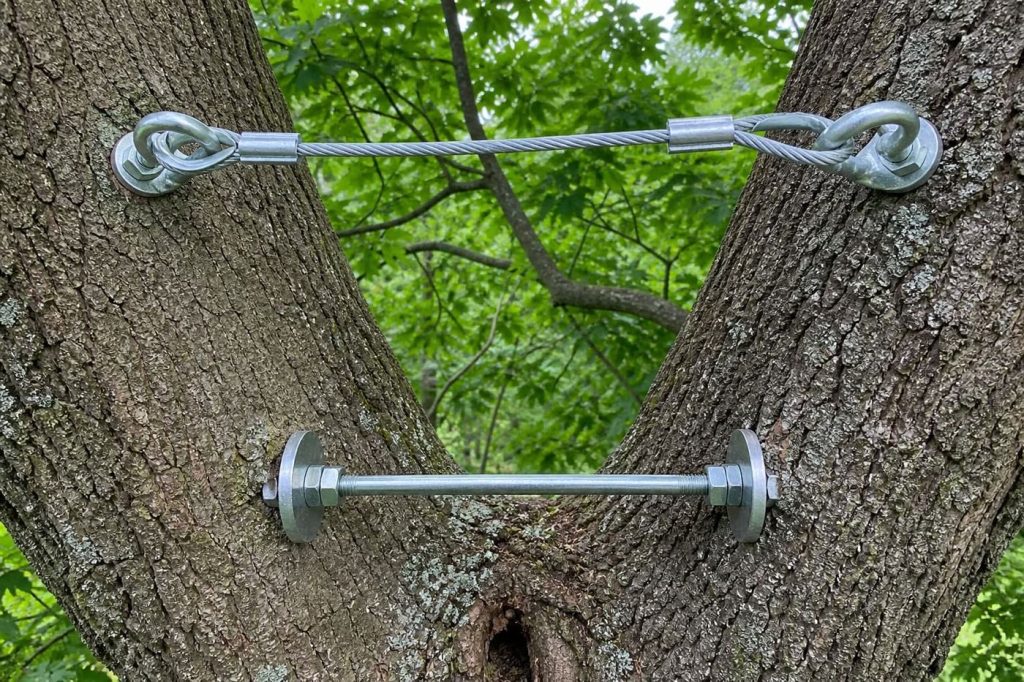
The failure that cabling is designed to prevent
Walk any older neighborhood in Danville — the Old West End, Forest Hills, the streets around Ballou Park — and you’ll find big maples and oaks that split into two trunks a few feet off the ground.
That’s a codominant stem, and where the two stems meet there is often included bark: bark grown into the union instead of wood. A union with included bark has no structural connection holding it together. It’s two trees leaning against each other. It holds fine for decades, then splits in one storm, usually taking half the canopy — and whatever’s under it — with it.
Where the tree is otherwise sound and worth keeping, that union can be supported.
What a support system actually is
Cables are installed high in the canopy, typically about two-thirds of the way from the defect to the branch tips. They limit how far the stems can move apart in wind without holding them rigid — trees need to flex, and a rigid system just relocates the failure.
Braces are threaded steel rods installed through the union itself. They resist the twisting and pulling that cables can’t, and they’re used where a split has already started.
Both are covered by ANSI A300 Part 3, the industry standard for supplemental support systems. It specifies hardware sizing, placement, and — the part that matters most to you — inspection intervals.
A cable is a commitment, not a repair
This is the honest part most companies skip.
A support system does not fix the defect. It manages it. Hardware needs inspection — annually is the standard recommendation — because a cable that has corroded, loosened, or been swallowed by growth is worse than no cable at all: it gives the owner confidence in a tree that is no longer supported.
If you install a system and never look at it again, you have bought a false sense of security. We’ll tell you that before we quote it, and we’d rather remove a tree than sell a cable to somebody who won’t maintain it.
The health side — what's actually killing trees here
Emerald ash borer. The Virginia Department of Forestry calls it “the most destructive forest insect ever to invade the United States,” having killed hundreds of millions of ash trees across the country. Untreated ash in an infested area is generally not survivable. Treatment exists and only works if it starts before the canopy has thinned significantly — and a Virginia Department of Forestry cost-share program can offset the expense. Once it’s dead, ash gets brittle unusually fast, which makes late removals more dangerous and more expensive.
Southern pine beetle. VDOF’s characterization: the most destructive native forest pest in the Southern U.S. It generally attacks stressed trees, but at outbreak population levels it overwhelms healthy ones. Needles fading yellow to red to brown over a few weeks means that tree is already gone — and the concern shifts to the pines standing next to it.
Construction damage. The most common slow killer in a growing area, and the most preventable. Grade changes, trenching through the root zone, and equipment compacting soil under the canopy kill mature trees on a three-to-seven-year delay, long after the builder is gone. If something is being built near a tree you care about, the time to talk is before the machines arrive.
Cabling work concentrates where the old trees are: Chatham‘s pre-war canopy, the historic districts in Reidsville, and the tree-lined streets of South Boston. Related: tree removal when a tree is past saving, and trimming and pruning for the structural work that prevents the problem.
Not sure how bad it is? We will come look and tell you straight. The estimate is free.
Tree Health FAQs
How do I know if a tree is worth saving?
Roughly: species and site quality, how much sound wood is left, whether the defect is supportable, and what’s underneath it. A structurally marginal tree over an open field is a different decision from the same tree over a bedroom. We’ll give you a straight assessment either way.
How long do cables last?
Properly installed hardware can serve for many years, but it is not permanent and it is not maintenance-free. Plan on annual inspection and expect eventual replacement.
Is deep root fertilization worth it?
Usually not by default. Most established trees in this area aren’t nutrient-limited — they’re limited by compaction, drainage, and root damage. Fertilizing a tree with a root problem just grows canopy the roots can’t support. We’d rather look at the soil first.
Call (434) 216-5589 for a free assessment.
Get a Free Estimate
Call and you will talk to somebody local.
Or send us the details and we will come look.