
Tree Trimming and Pruning in Danville, VA
Danville Tree Care & Removal prunes trees to ANSI A300 standards across Danville and Pittsylvania County — crown cleaning, crown reduction, deadwooding, and clearance over roofs, driveways, and service lines. We do not top trees. Free estimates. Call (434) 216-5589.
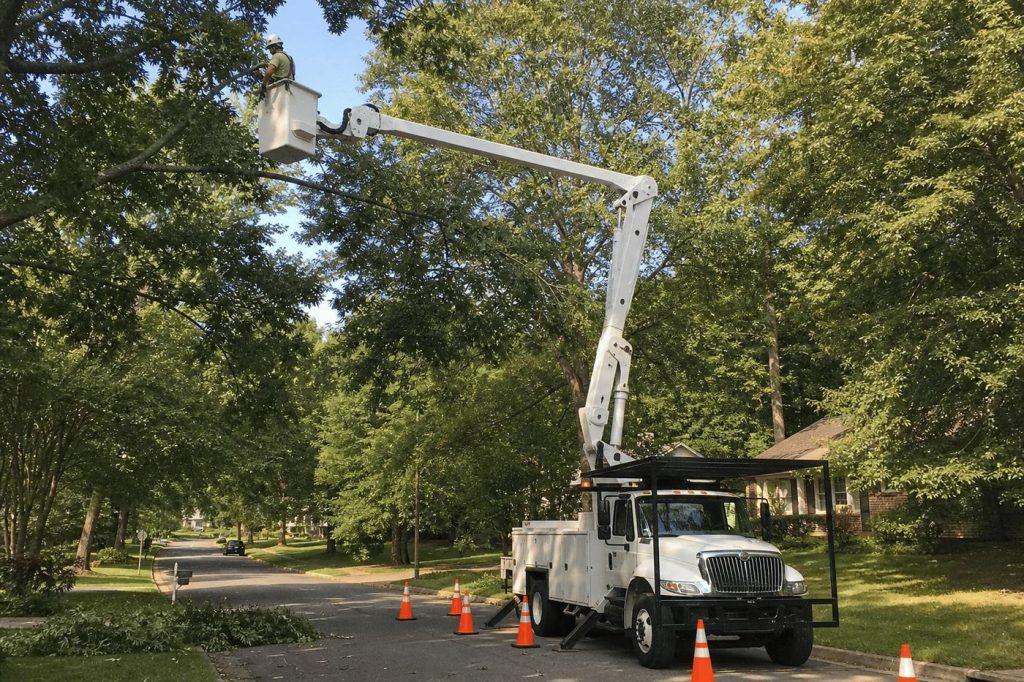
The four kinds of pruning, and which one you probably need
Most people call it “trimming.” The industry standard, ANSI A300, breaks it into distinct operations, and knowing which one your tree needs is most of the battle.
Crown cleaning removes dead, dying, diseased, and broken branches. It’s the default maintenance prune and it’s what most residential trees actually need.
Crown thinning selectively removes live branches to reduce density. Done well, it improves light and air movement. Done badly — stripping the interior and leaving foliage only at the tips, called lion-tailing — it makes the tree more likely to fail.
Crown raising lifts the lower canopy for clearance over a driveway, a walk, or a street.
Crown reduction shortens the overall height or spread by cutting back to a lateral branch large enough to assume the terminal role. This is the correct way to make a tree smaller. It is not topping.
Why we won't top a tree
Topping is cutting a canopy back to stubs, with no regard to where the cuts land. It is a violation of ANSI A300, and it does three things, all bad.
It starves the tree by removing the foliage it feeds on. It opens large wounds in the middle of branches, where a tree cannot compartmentalize decay — so rot starts at every cut. And it forces a flush of weak, fast-growing water sprouts anchored only in the outer layer of a decaying stub. Those sprouts grow back taller than what was removed, and they break in the next storm.
A topped tree costs less this year and costs far more in five. Crews top because it’s fast and requires no judgment.
When should trees be trimmed in Southside Virginia?
Late winter dormancy — roughly January into early March — is ideal for most hardwoods here. No leaves in the way, so structure is visible. Low insect and disease pressure. And the tree responds vigorously in spring.
Some exceptions: oaks are best pruned in dormancy to avoid oak wilt vectors, and heavy pruning of spring-flowering ornamentals right before bloom will cost you the flowers. Hazard pruning and storm damage happen any time of year — a broken limb hanging over a bedroom is not a seasonal decision.
Trees, limbs, and power lines
This is the part people get badly wrong.
Inside the city, Danville Utilities is the electric provider — the largest of Virginia’s 14 municipal systems, serving roughly 42,000 customers across 1,250 miles of line in the city and parts of Pittsylvania, Henry, and Halifax counties. Much of Pittsylvania County is served instead by Dominion Energy, with Appalachian Power, Mecklenburg Electric Cooperative, and Southside Electric Cooperative covering other pockets — five utilities in one county.
Dominion’s published Virginia policy is a useful benchmark: it clears roughly 20 feet above and 15 feet to the side of primary distribution lines in rural areas, works neighborhood lines on about a four-year cycle, will not remove trees, and will disconnect your service drop free of charge so a tree near it can be taken down safely. Virginia’s High Voltage Safety Act requires contacting the utility before work near energized lines.
Call your provider first. Never let a crew work near an energized line unless they are line-clearance qualified. We aren’t shy about telling you when a job belongs to the utility instead of to us.
We prune across the whole service area. Two towns worth checking before you book: Chatham caps curbside brush at 3 inches, and Gretna requires a contractor to hold a town license before cutting anything at all. Full list of service areas.
Not sure how bad it is? We will come look and tell you straight. The estimate is free.
Trimming FAQs
How high does Danville require limbs to be kept over a sidewalk?
Twelve feet. City code Sec. 35-14 requires shade tree limbs to be maintained above 12 feet over sidewalks and streets, and gives the Director of Public Works authority to have it done if an owner doesn’t.
How often should a mature tree be pruned?
Most healthy mature hardwoods need attention every three to five years. Young trees benefit from structural pruning every two to three years, and that early work is the cheapest insurance you will ever buy on a tree.
Will trimming hurt the tree?
Correct pruning won’t. As a rule of thumb, removing more than about 25% of a mature tree’s live canopy in one season is stressful, and a crew that wants to take half of it is not doing you a favor.
Call (434) 216-5589 for a free estimate.
Get a Free Estimate
Call and you will talk to somebody local.
Or send us the details and we will come look.